The rapid integration of Generative Artificial Intelligence (GenAI) into the art world has sparked debates on its authenticity and creative value. This study investigates public perceptions of AI-generated art, focusing on changes in interest and interpretation before and after disclosure of GenAI’s involvement. Grounded in theories of generative art and kitsch, it examines how GenAI evokes both admiration and criticism. Using an explanatory sequential mixed-method approach, a survey of 553 respondents evaluated interest, emotional reactions, and the ability to distinguish AI-generated from human-made artworks. Quantitative data revealed a decline in interest postdisclosure (overall mean: 5.09 to 4.75), while qualitative insights highlighted polarised views on AI’s role in art. Respondents praised GenAI’s technical sophistication and democratising potential but criticised its lack of emotional authenticity. It identifies contrasting perceptions of GenAI in art, emphasising the need for ethical considerations and a redefinition of artistic values as technology reshapes creativity and aesthetic judgement.
This is an excerpt from a published paper in “Jurnal Desain” https://doi.org/10.30998/jd.v12i3.26970
INTRODUCTION
The vast development of Artificial Intelligence (AI) has expanded its trajectory from discriminative towards generative models based on human language, also known as Generative Artificial Intelligence (GenAI), with text-to-text and text-to-image outputs among others (Gozalo-Brizuela & Garrido-Merchan, 2023). This paper focuses on text-to-image GenAI and its impacts on art because the role of the machine as a “creator” will directly impact an industry primarily built by the creation process. Furthermore, the democratisation of GenAI, as demonstrated by the emergence of accessible platforms such as Dall-E, Midjourney, and Leonardo, has broadened the scope of creators from selective professionals to the general public.
In the art scene, artists like Mario Klingemann and Goodby Silverstein & Partners have integrated GenAI into their art-making process by exploring the unconscious reality using AI-made dreamlike imagery (López-Varela Azcárate, 2023). In this way, both artists aimed to surpass the boundaries of the conservative medium, hence considered an acceptable usage of GenAI. However, there was a strong reaction when an AI-made artwork won a digital art photography contest at the Colorado State Fair (Roose, 2022), primarily highlighting the need to separate the competition for exclusively human-made artwork and hybrid artwork, for example, the Dezeen competition for its AItopia editorial series (Barker, 2023). Beyond the digital realm, a humanoid robot was trained to mimic the gesture of painting to produce tangible artwork on canvas (Cain, 2024).
Nevertheless, art is not limited to the end product and the producer, but a collective ecosystem consisting of multiple actors, including the viewers who judge, interpret, and contemplate the artwork, making the perception of art, both in traditional and contemporary contexts, a multifaceted cognitive and emotional process (Becker, 1982). In the discourse of GenAI usage in art, it is essential to include the perspective of the viewers, which is addressed in this paper. The research questions are as follows: (1) How do respondents interpret and value the artworks before and after learning about GenAI involvement?; (2) How do respondents explain changes or consistency in their perception of the AI-generated artworks?; and (3) How do respondents perceive the usage of GenAI in the art world?
This study addresses a literature gap by examining the nuanced shifts in public perception towards AI-generated art, focusing on how these perceptions change before and after learning about AI involvement. While previous research has primarily explored the technical and philosophical implications of AI in the art world (Chesher & Albarrán-Torres, 2023; Horton Jr et al., 2023), there has been limited empirical investigation into the emotional and cognitive reactions of diverse audiences, particularly in the context of public engagement with GenAI in art.
It chooses the term kitsch (Greenberg, 1939) to contextualise the perception of AI-generated art within the broader art discourse. Historically, kitsch has been associated with art that is easily accessible, emotionally shallow, and often regarded as lacking depth. Emerging alongside avant-garde movements, kitsch became a point of contrast, frequently evoking debates about authenticity, originality, and societal values in art. In the postmodern era, this dichotomy has blurred, with artists like Jeff Koons reclaiming kitsch elements to create works celebrated as high art, bridging the divide between popular and elite culture (Ortlieb & Carbon, 2019).
The term kitsch aptly captures the tension between creativity and mass production. AI-generated art often relies on patterns and clichés drawn from vast datasets, resonating with kitsch’s reliance on mundane, comforting themes rather than groundbreaking originality. This resemblance raises questions about the role of AI as a creator and its ability to produce art that transcends surface-level appeal. By adopting kitsch as a conceptual lens, the paper explores the duality in public reception, where AI art is both admired for its technical sophistication and critiqued for lacking emotional authenticity (Ortlieb & Carbon, 2019), this study introduces a novel approach to understanding AI-generated art. Furthermore, it emphasises the impact of transparency on the perception of AI involvement, offering fresh insights into how disclosure influences the perceived authenticity and value of the artwork. By identifying these perspectives, this research contributes to the discourse on human-AI artistic collaboration, informing ethical discussions and future policy considerations in the creative industries.
METHODOLOGY
[…]
KITSCH AND THE PERCEPTION OF ART
The experience of art is a complex interplay of aesthetic emotions and cognitive evaluations, encompassing factors such as artistic techniques, historical significance, and presentation (Tröndle et al., 2014). These evaluations often invoke emotional responses ranging from fascination and surprise to boredom and even displeasure (Menninghaus et al., 2019). Such responses are critical in defining the public’s engagement with art. For instance, familiarity with an artist or a distinctive style significantly influences aesthetic judgements, as evidenced by studies showing reduced appreciation for artworks falsely attributed to renowned artists like Van Gogh (Leder, 2001).
Modern art, however, demands a deeper interpretative effort than earlier artistic traditions that championed masterful techniques. This increased complexity enhances viewers’ cognitive and emotional engagement, fostering a richer aesthetic experience (Leder et al., 2004). Digital reproductions seen on brochures or the internet are often perceived as less impactful than original artworks, underscoring the importance of tangible, authentic encounters in heightening aesthetic judgement (Reymond et al., 2020).
Generative art is a broad domain encompassing various forms of automated and semi- automated creative processes, predating the advent of digital technology. The term primarily refers to art partially or entirely created through systems that exhibit a degree of autonomy, whether physical, mechanical, or computational (Dorin et al., 2012). These systems engage with their environment to produce sensory outcomes, often emphasising the iterative nature of the artistic process.
Boden & Edmonds (2009) developed a category consisting of eleven generative art clusters based on their form, including C-Art, D-Art, R-Art, and VR-Art, which stand for computer, digital electronic technology, robot, and virtual reality art. This illustrates the diversity within this term. Moreover, despite its recent digital prominence, generative art’s roots can be traced to the mid-20th century, when conceptual and performance art leveraged randomness and process-oriented methods to challenge traditional artistic norms (Dorin et al., 2012). In AI- generated art, users must acknowledge the “calculated randomness” of the incomprehensible and unpredictable nature of the machine to create exact results (Dzhimova & Tigre Moura, 2024).
The integration of GenAI into art production represents a significant evolution in generative art. GenAI operates by reorganising and synthesising data using complex algorithms, enabling the production of works that mimic, and occasionally challenge, traditional artistic outputs (Tao, 2022). However, the absence of intrinsic understanding in AI systems underscores their reliance on probabilities and patterns rather than genuine creativity or symbolic meaning. The involvement of AI in art has sparked both fascination and skepticism. Collaborative efforts between human artists and AI systems often yield works perceived as more valuable than AI- only creations, emphasising the importance of human contributions in maintaining authenticity and relatability (Horton Jr et al., 2023). Nevertheless, AI-produced works frequently elicit an “uncanny valley” effect, evoking audience discomfort or suspicion (Tao, 2022).
The perception of AI-generated art is further influenced by the identity of its creator. Research indicates a pronounced bias against artworks explicitly attributed to AI, particularly in fine arts contexts, where human effort and originality are highly valued (Hattori et al., 2024). Conversely, this bias diminishes in commercial applications, suggesting that perceptions of creativity are context-dependent (Magni et al., 2024).
In the context of AI-generated art, the viewer’s perception is shaped not only by the artwork’s intrinsic qualities but also by their awareness of its production process. This interplay between the artwork, its creator, and its audience underscores the necessity of understanding how the knowledge of AI involvement influences public engagement with art. As GenAI continues to democratisise artistic creation, it challenges long-standing notions of artistic authenticity and creativity. This evolving dynamic calls for a nuanced examination of public sentiment and its implications for the future of art.
INTERPRETATION OF ARTWORKS
An experimental approach was implemented while creating the AI-generated images. Various prompts and aesthetic styles were tried to craft a mixture of realistic, beautiful, and evocative images that could easily deceive the viewers. Generally, images that depict humans and Indonesian culture, as in the paintings of Raden Saleh or Basuki Abdullah, were unrepresentative due to inaccuracies.
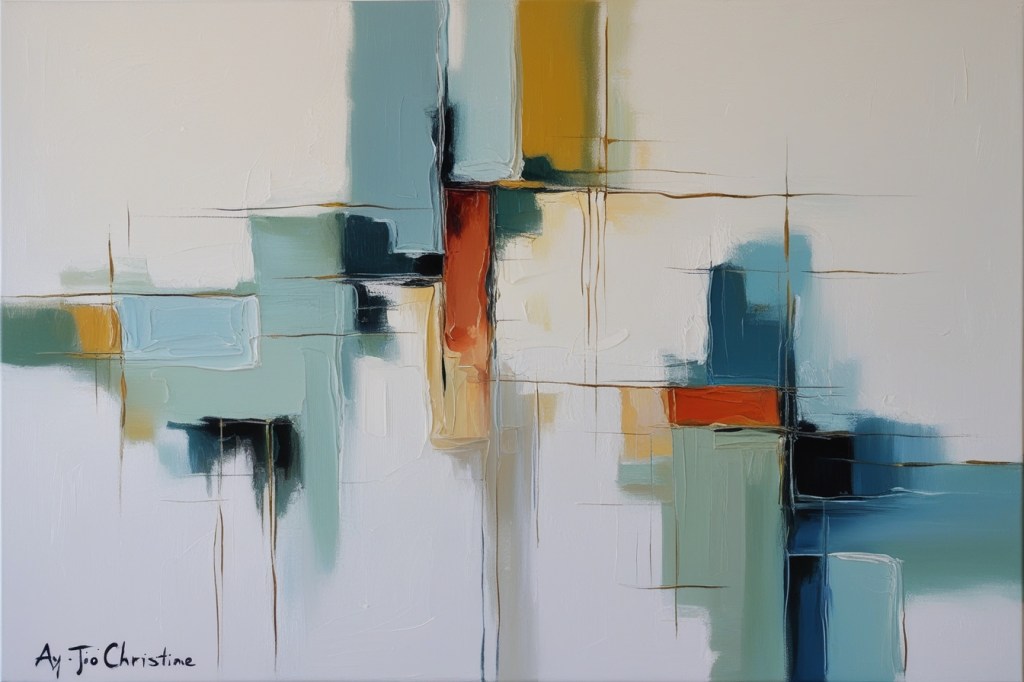
In Table 1, the three final images were generated using intricate prompts, with two of them mirroring the style of Tisna Sanjaya and Ay Tjoe Christine. Not only using specific sentences to describe the appearance, such as “a large-scale charcoal on canvas artwork” and “carcasses and grave soil,” the prompts included the intended meaning to be portrayed, namely the death of democracy in Image 1 and social justice in Image 2. Instead of using a shorter, looser prompt like “an art installation representing something,” this descriptive, straightforward approach was taken to enhance the image quality. The prompt of Image 1 also incorporated the detailed gallery environment by mentioning wooden floors, white walls, and art barriers.
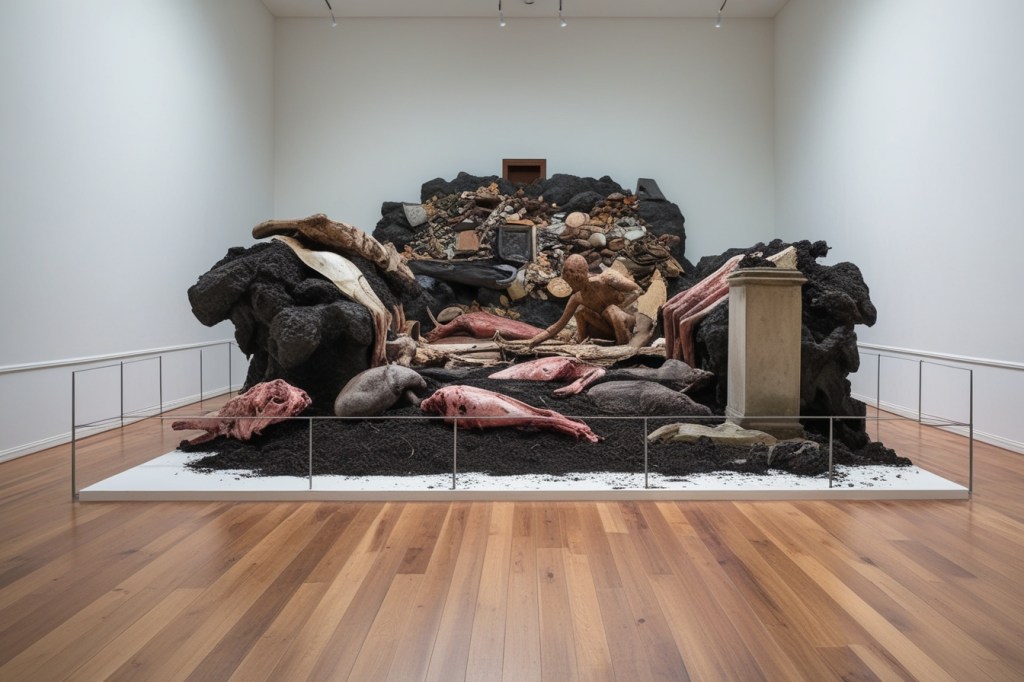

Prior to knowing the artworks were AI-generated, viewers were tasked to interpret the images and describe the perceived meaning in three separate open-ended questions. The perceived themes varied, but most did not match the intended meaning of the prompts. For example, rather than about politics, responses towards Image 1 leaned toward environmental issues related to land waste and polluted oceans. Image 2, on the other hand, was perceived as a manifestation of psychological problems like loneliness, social pressure, and feeling trapped inside the mind. In contrast, Image 3 did not bring a specific theme to mind, representing the challenges of interpreting abstract works.
To enhance respondents’ understanding of the research context, they were presented with multiple choices and asked to choose three options as the most important factors that constitute art. The top four answers are: (1) theme, concept, and message; (2) aesthetic and/or beauty; (3) the ability to evoke emotion and/or inspiration; and (4) production technique and/or the artists’ skills. The respondents’ emphasis on aesthetics and themes aligns with kitsch, simplifying art’s emotional and conceptual complexity to make it universally appealing (Ortlieb & Carbon, 2019).
PERCEPTIONS TOWARDS AI-GENERATED ARTWORKS
Although the misspelt name of Ay Tjoe Christine and the distorted art barrier structure might provide clues about AI-generated images, only 34.72% of respondents (n=192) suspected the artworks were made by machines. Some respondents pointed out the glitch mentioned before, while some active in the art scene noticed they had never seen the artwork in person or the media, raising suspicion. One respondent, in particular, was a Leonardo AI user, so even though he could not pinpoint the distinctive aspect that set the images apart from real artworks, he believed AI-generated images have specific characteristics. Those familiar with text-to-image GenAI also doubted the authenticity for various reasons, such as the visuals being too neat and eerie, giving an uncanny experience, or “too much.”
For the remaining 65.28% of respondents (n=361), it did not cross their minds that the artworks were not real photographs, and the survey was to evaluate that. The main reason was the exceptional resemblance to manual artworks, notably in Image 2, even though it resulted from the highly descriptive prompt: “expressive style, applied in bold, gestural strokes, and textured layers.” Another prominent reason was the lack of awareness about the art scene or the aptitude of the current GenAI model. Though the existence of GenAI is widely acknowledged, not everyone understands the full extent of its capability.
Respondents were then asked to write three emotions that came to mind after knowing the truth. The research captured spontaneous, unrestricted responses by not incorporating multiple choices in this part. The most frequent words included “sad,” “upset,” “angry,” “surprised,” and “not,” which was a shortened response from “not believable” or “not expecting.” Nevertheless, positive sentiments such as “good,” “unique,” “interesting,” “cool,” and “amazed” were also notable, representing the duality of responses that will continuously appear in the following sub-chapters. Still, these responses might change if respondents already knew about AI involvement since the beginning, eliminating words like “surprised” at the very least. The full result is visualised as a word cloud in Figure 2 using Bahasa Indonesia.
The research measured interest in the artworks twice, before and after the disclosure of GenAI usage, summarised in Table 3. There is a consistent lowering of interest in all images from the overall mean score of 5.09 (quite interested) to 4.75 (neutral), with the most significant decline in Image 1 with -0.46. In addition, the most significant changes depicted in Table 4 are 6 (interested) and 5, which solidify the decrease towards a more unfavourable perception. Still, this finding does not represent the whole since, in contrast, the perception shift also accommodates elevated interest in some respondents. The increase in the most frequent value of Image 1 from 5 to 7 (very interested) and the addition of the number of respondents who chose 7 from 145 to 147 in Image 3 speak to this anomaly. The rising standard deviation also supports these differing perspectives.
In other words, while the mean score of perception change is 4.66 (SD=1.91), it represents both changes towards more interested and less interested, which can be tied back to the question about what constitutes art. In Figure 3, a thematic analysis based on the open-ended questions reveals four reasons behind the changed perception, three reasons behind the unchanged perception, and four more reasons for the respondents’ neutral attitude.
[…]
ABILITY TO DISTINGUISH AI-GENERATED ARTWORKS
[…]
RESPONSES TOWARDS GENAI IN ART
[…]
CONCLUSION
This study examines contrasting perceptions of AI-generated art by analysing how public interest and interpretations shift upon disclosure of GenAI involvement. Drawing on theories of art perception, generative art, and the concept of kitsch, the findings illuminate the duality in how audiences engage with AI-created artworks, prompting a nuanced look at each case.
Before learning about GenAI involvement, respondents generally expressed moderate interest in the presented artworks, with an overall mean score of 5.09. However, post-disclosure, this interest declined to a neutral level of 4.75, highlighting the tension between initial visual appeal and subsequent scepticism. These contrasting perceptions underscore biases against AI as a creator, particularly regarding its perceived lack of emotional authenticity and originality, qualities central to traditional notions of art.
Respondents’ reactions revealed a spectrum of sentiments. Some were captivated by GenAI’s technical capabilities and democratising potential, which broadens creative participation. Conversely, others expressed disappointment, citing the loss of emotional resonance and personal connection they associate with human-made art. These opposing views reflect kitsch’s duality: its accessibility and aesthetic appeal juxtaposed with its perceived superficiality.
The findings also spotlight challenges in distinguishing AI-generated from human-made artworks. While this reflects the sophistication of GenAI outputs, it raises concerns about transparency and trust in the art world. For many respondents, knowledge of AI involvement diminished their connection to the artwork, emphasising the critical role of authorship in shaping artistic value. However, this might change if the work maintains transparency by noting AI involvement from the beginning.
Overall, this study identifies a pivotal cultural moment where GenAI reshapes artistic boundaries, fostering admiration and critique. Undoubtedly, unveiling these contrasting perceptions underscores the importance of addressing ethical considerations and redefining creativity in an era where technology and art increasingly intersect to ensure fairness.
FULL PAPER
Download link here
HOW TO CITE
Wiradarmo, A. A. & Azhar, H. (2025). Machine kitsch theory: Contrasting shifts in public perceptions towards AI-generated art. Jurnal Desain, 12(3), 608-622. https://doi.org/10.30998/jd.v12i3.26970
REFERENCES
On the full paper

 CREATIVE TECHNO-MORALITIES
Leave a comment